

What is Vibe coding for?
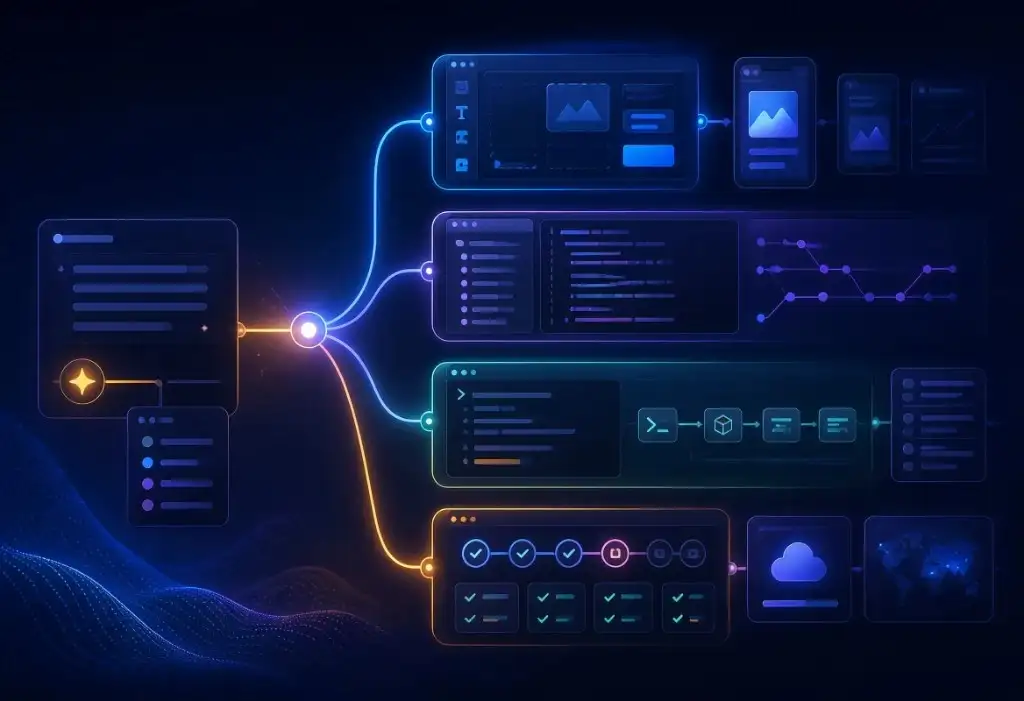
Vibe coding uses generative AI to rapidly turn requests ("prompts") into working software. Entrepreneurs and research teams inside larger companies can quickly prove out ideas in hours instead of days or weeks. These builds can be deployed for early feature testing with alpha customers, colleagues, and potential investors.
At this point in time, vibe-coded applications are often not scalable or fully secure enough to put real money through them without some more experienced assistance from software professionals.
Is Vibe coding good or bad?
Vibe coding is good when speed matters more than perfection, especially for early prototypes, internal tools, and experiments where you want to experiment iteratively. It can feel like the future of programming because non-technical teams can now build real products with a Vibe coding app or Vibe coding IDE.
Vibe coding is bad when teams assume a fast prototype is automatically production-ready. The most common issues are security gaps, weak data validation, missing tests, and a codebase that becomes hard to maintain after many AI-driven iterations. The goal is not to stop vibe coding. The goal is to improve vibe-coded software so it can be trusted and scaled.
What tools are out there for Vibe coding?
There are now many Vibe coding tools that are often discovered through searches like ‘build an app with AI,’ ‘AI app generator,’ ‘no‑code AI builder,’ or ‘fix my Vibe app'. These platforms take human‑generated prompts and use generative AI to produce new application code. For example:
"Please create an application that simulates cars going through a toll gate. Some drivers will pay cash, others need to drive through at a certain speed or lower. This should be a chronological simulation."
We have worked with clients who use tools like Base44 and Lovable, which provide a managed dashboard experience and a fast, output-driven environment. This is vibe coding. A main part of these platforms is the prompt interaction for asking for new/changed features and allowing review, rollback, or further prompting. The tools have matured along with the generative AI models, and we are seeing non-technical users produce impressive applications with many layers of functionality.
The ecosystem nature of these tools can also lock in the use of the tools. With Lovable you can select your own backend to use, and many Lovable applications use Supabase as their backend. Base44 writes applications using their backend API, so your applications are Base44 dependent. Under the hood Base44 also uses Supabase, although they abstract that away from you.
For more flexibility, some clients are using Claude Code and Cursor for vibe coding. Cursor vibe coding (also searched as vibe coding with Cursor, vibe coding Cursor, cursor for vibe coding) offers less vendor lock-in because these tools generate fully standalone application stacks that deploy well to managed environments like Vercel or Heroku.
How do we work on ongoing Vibe coding with clients?
1. Audit and add to the codebase and ecosystem integration
Using the same principles that we have used for almost 10 years, we highlight what is missing to make vibe code production-ready. These enterprise features often include:
- Environment separation: The user acceptance testing (UAT) environment should not bleed into the production environment
- Security and secrets: Confirm the vibe-coded application uses best practices for secrets management, authentication, authorization, and data validation
- Unit testing and Continuous Integration: A good test suite and CI pipeline lets teams embrace change instead of being scared of it
We work with clients to add these development operations features for long-term scalability and stability.
2. Review the UI/UX design and implementation
Generative AI solutions are often additive rather than efficient. After many iterations this results in a more bloated codebase and overlapping UI/UX. We provide an honest assessment of how the current UI/UX reflects usability and branding, then propose specific improvements.
Our design process can help re-imagine and streamline portions of the application. Vibe coding tools can now accept screenshots for new functionality, or accept Figma designs with the help of plugins like builder.io.
3. We create a process for ongoing Vibe coding
Clients should be able to keep innovating and focusing on new business logic for their customers. At the same time, vibe-coded changes should be carefully reviewed, corrected, tested, and safely moved to production when ready.
We set up human/machine pipelines: vibe coding happens in its own isolated branch of code and can be deployed separately for a first round of testing using the vibe coding platform's native tools. Those branches are then exported to more traditional platforms like Microsoft GitHub where we can run unit tests and automatically build code. We run our AI-assisted code review process. Our development team works alongside clients and generative AI to make changes.
We often have to get creative with the platforms, for example: cloning new applications to simulate different development branches, and figuring out how to re-import updated code back into the vibe coding platform from Microsoft GitHub.
Advantage: vibe coding platforms can work well with code additions/changes that their core models did not make. Current generative AI models are very good at adapting to different styles and working with more rigorous test suites which can even provide feedback to the platforms, for example: "This test failed with this, please fix it."
What are the challenges with Vibe coding?
Vibe coding is largely output-driven and does not focus on long-term maintainability and stability of the codebase. Even when tools like Claude Code or Cursor generate more deployable code, mistakes are still common, and using a calculated mix of generative AI models is often best.
Generative AI does not try to be terse or efficient. It will often continue to add on top of what has already been written rather than refactoring for clarity and performance. That is why productionizing vibe code typically requires security hardening, testing, code cleanup, and a repeatable release process.
We at Future Wonder can help you strengthen and productionize your vibe-coded product so you can build revenue while securing your product. Contact us when you are ready.