

Part 1: Today's AI Landscape
We've witnessed an explosion of large language models (LLMs) transforming our digital workflows, and while they're not always correct, we're finding they can be tremendous productivity multipliers. In our day-to-day work, we've seen that LLMs can draft code, generate content, and automate repetitive tasks in a fraction of the time it would take us to do manually.
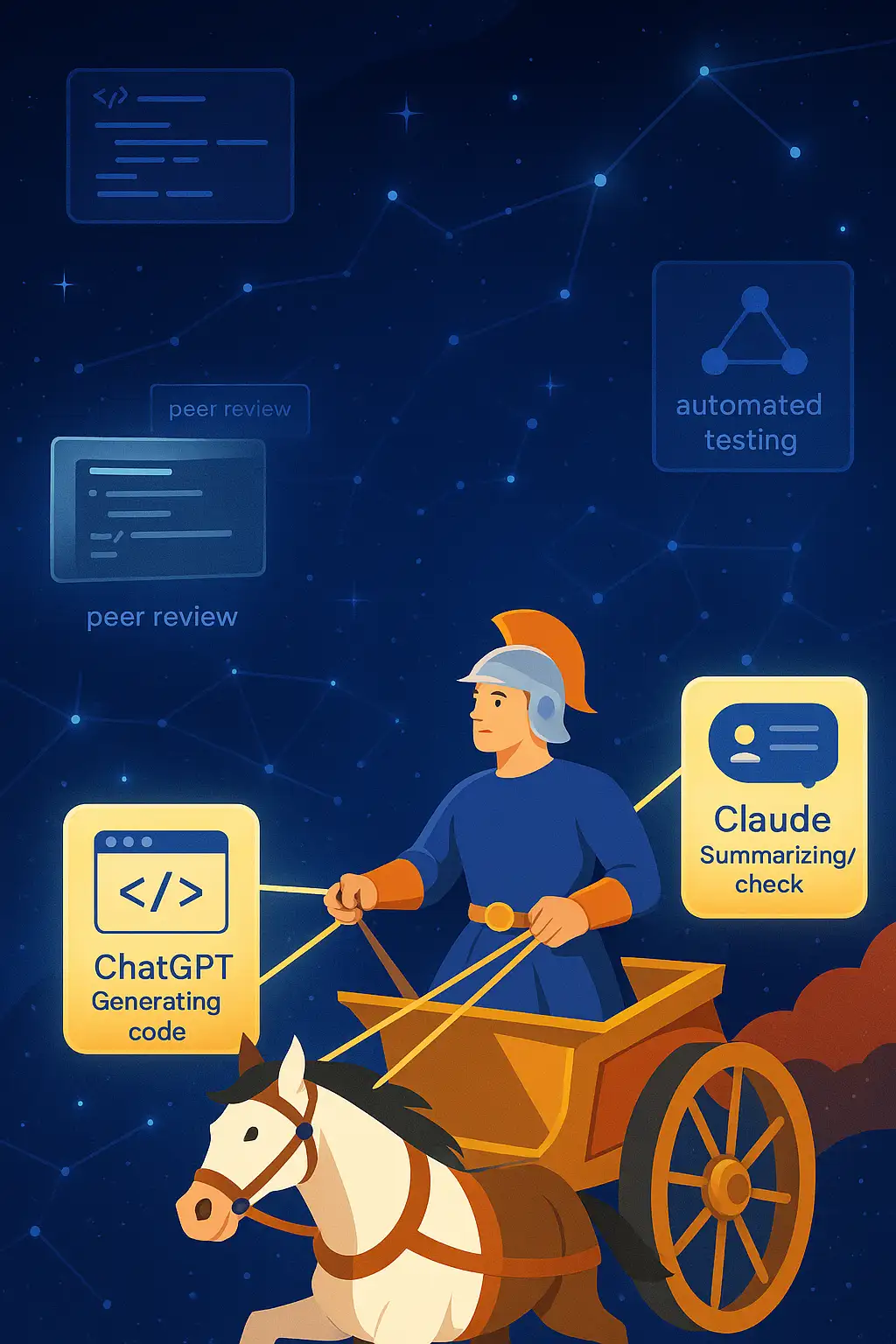
What's truly exciting for us is the transition toward AI agents capable of self-correction, often operating as part of what researchers are calling a "constellation" of specialized models. Recent academic work from Hippocratic AI demonstrates how these systems can collaborate to achieve more reliable outcomes than any single model. We're fascinated by how this mirrors human teamwork - different specialists coordinating to solve complex problems.
We're finding that our greatest successes come from embracing our unique strengths alongside AI capabilities. Peer review remains essential - we're exploring how AI can formally check and correct our work while maintaining human oversight. In coding projects, we've discovered that AI performs dramatically better when provided with structured environments like test suites. This two-way relationship - AI generating code from tests, or tests from code - exemplifies the collaborative potential we're only beginning to tap.
The multi-model approach is already proving successful in tools like Plandex, a coding agent that combines strengths from Anthropic, OpenAI, and Google to achieve significantly better results than any single provider's models. With capabilities including automatic context management and configurable automation, it represents a shift toward AI systems that can handle complex tasks while still needing human guidance. Tools like Cursor can now automatically retry failed generations with different approaches, showing how AI adaptivity can complement human creativity.